The Michl 7: Seven Ways to See
By Vladimir Michl – 2025, v1.1
"Nobody knows why. Be positive. Simplify once, share now."
It is a phrase I use to remember seven principles — seven ways to see — that form a compact thinking model to navigate complexity, make better decisions and execute effectively, all that sustainably with minimal overhead. There are no limits to applying this model, for personal growth, for a team or even a whole company. It is meant as a guide, to help you discover a way, not a step by step process.
It is not as minimal as I hoped originally, now with seven principles, seven communication tips and a few other concepts, it forms a practical and comprehensive model guided by a minimalist mindset. Since I put the seven principles together, I call it simply "The Michl 7".
The Principles
The seven principles are "Nobody knows?", "Why?", "Be positive", "Simplify", "Once", "Share", and "Now".
The principle names should be self-explanatory and are really supposed to mean what they say, so do not overthink it and take these on face value. Slight provocativeness is on purpose, to help you see from new perspectives.
Saying that, here are a few bullet points for each principle, with a bit more details:
-
Nobody knows? (Humility, Open-Mindedness)
- Nobody knows because critical information is often inaccessible — wrong location, wrong permissions, forgotten, or simply wrong.
- Good process assumes minimal initial knowledge, since that is what the process should help with.
- Document; what is in your or others’ memory will get lost.
- Use real data to make decisions, unless impossible.
- Cross-reference what you can, even experts are wrong.
- Understand your assumptions; assume incomplete knowledge and overconfidence in what you know
-
Why? (Purpose, Curiosity, Critical Thinking)
- Ask why we are doing it, what is the end goal.
- Ask recursively (i.e. "5 Whys") to discover the real reasons, not just symptoms.
- Keep asking Why?, new information can change the goal or the solution.
- Don’t be afraid to retrace your steps right from the start with fresh eyes.
- Investigate system or process issues, before focusing on individuals.
-
Be positive (Realistic Optimism, Openness, Psychological Safety)
- Assume good intent.
- Focus on solutions, constructive dialogue, and path forward.
- Treat every failure as a learning opportunity.
- Notice the positives in difficult situations, you will find some.
- Be open to new experiences. Welcome and seek feedback.
- It may be easier to change yourself than the world around you.
-
Simplify (Essence)
- Keep things simple. Both incrementally and as a system.
- Default to zero exceptions. Some inevitably becomes many; that creates complexity.
- Think about the next team; what you make today, someone else maintains tomorrow.
- Be kind to yourself, your working memory is limited to roughly seven items (Miller’s Law), so you will lose track quickly.
-
Once (Precision, Efficiency)
- Do it once. Do it right.
- Have only one copy of data, systems, functions, etc. (i.e. Don’t repeat yourself).
- Reuse where you can.
- Fix issues once for all.
-
Share (Connection, Collaboration, Openness)
- Release what you create.
- Spread knowledge, code, tools, and context. No sharing, no scaling.
- Offer feedback if appropriate.
- Now (Urgency, Timeliness, Focus)
- Bias for decision and action. Momentum beats perfection. Later may mean never.
- As soon as something is useful.
- Iterate — Work in small steps (i.e. MVP, prototypes, drafts) to learn quickly and adapt.
"Nobody knows?", "Why?", and "Be positive" form the learning core, enabling moving forward in any situation. Through application of these three principles, one can discover the rest of The Michl 7. It may take a while, therefore the model includes all seven, as a practical essential set. There could be perceived overlap between some principles, but the model is focused on practicality, therefore different angles, even if on the same thing.
It is possible that parts of The Michl 7 challenge cultural norms. First ask yourself if the norms should really be challenged and if your answer is no, try to adapt it, find a gentler approach. In any case "Be Positive".
Tensions between the Principles
As you may have noticed, the principles are not harmonious, there are tensions between them. Unfortunately that’s a fact of life. The right way is usually some kind of compromise, being able to weigh options and choose the best path for the circumstances. It is not a simple process, nor a straightforward one, but being able to look from different angles, the choice can be informed and that is usually what matters. Also allowing yourself to admit that the chosen path was not right and based on new circumstances being able to choose different option, is a strength not weakness.
One can imagine the model as a cart wheel. The spokes are the principles, the rim and the hub are where the tensions are felt. If all the principles are in a good balance, the axle is at the centre of the wheel, so the cart ride is smooth. If some principles were to become more pronounced than others, the axle shifts off the centre and the cart ride becomes bumpy. If some principles were to overtake completely, the wheel may come apart, stopping the cart.
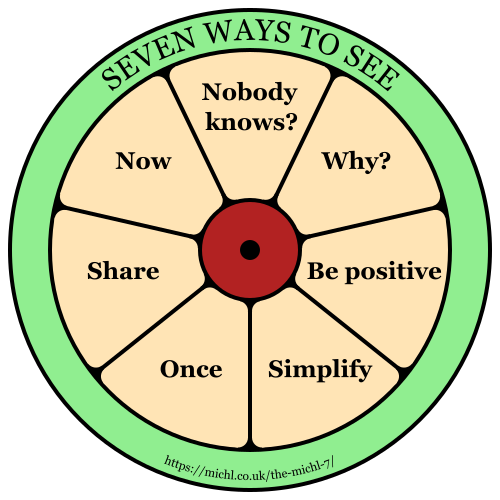
Here is a main set of the tensions worth mentioning, you may find others depending on your circumstances:
-
"Nobody knows?", "Why?", "Simplify", or "Once" vs. "Now"
Discovery, analysis, and refinement can all take time, so putting "Now" against them, allows one to ask "Have we done enough?", "Will we benefit from an iteration?", or just time box it. The perfection may not matter. -
"Nobody knows?" or "Why?" vs. "Be positive"
By nature "Nobody knows?" and "Why?" are about asking questions (relentlessly), which can sound critical or sceptical. "Be positive" insists on keeping the dialogue positive and constructive, to focus on a goal and resolution, instead of a blame. -
"Nobody knows?" vs. "Now" vs. "Once"
"Now" wants us to iterate, whereas "Once" needs thought and precision, so we do it just once. If we add "Nobody knows?" to the mix, it softens "Once" by allowing incomplete knowledge or solution. We can hold "Once" back to focus on the iteration rather than final goal, allowing for more quality feedback of the iteration. That satisfies "Now" by reducing a number of iterations. The Rule of 3 (see next chapter) could also be useful, if after 3 "Now" we are still not there, more "Once" is needed. -
"Share" vs. "Simplify"
Being able to communicate with the right level of details is an art. Communication is the transfer of information between people, which might have completely different context and vocabulary. What might be the right level of detail for one, could be over-simplified (therefore incomprehensible) or way too much detail (message can get lost) for someone else. So the tension is in being able to put the right level of detail for the audience of the message (an impossible task for varied audience). -
"Share" vs. "Now" vs. "Once"
"Share" wants us to communicate, "Now" wants it to be immediate, but that clashes with "Once" which values quality over quantity. The right balance depends on an audience. The larger the audience, the less detail they can digest. Equally, familiarity makes a difference, with a close team member, it’s easy to share ideas freely ("Share", "Now"), but that approach can fail when engaging with people from other teams or higher/lower in company structure. In those scenarios, we usually need to think more and communicate less often ("Once"). - "Once" vs. "Simplify"
"Simplify" is subjective and can mislead us into making quick, locally simple changes — duplicating functionality with slight tweaks or making incremental modifications that each seem simple in isolation. This approach can accumulate complexity and technical debt over time. "Once" pushes back by demanding we think through the broader system impact upfront, accepting a more complex change now to achieve genuine simplicity later.
As said, you can find others, the point is to embrace the tensions and deal with them as they come.
Rule of 3
Break the cycle rule. It is easy to get stuck in a loop, repeating the same thing again and again, without any real progress. The Rule of 3 is here to make you to stop, to reflect, to see if there is a better way. So if you have done the same thing 3 times, stop and reflect.
The three iterations ("Now") allow one to collect just enough data, to be able to see developing patterns or just do another 3 iterations if no insight was gained. Over time, one often develops sense of where things go, so may not need 3 iterations, to stop, reflect and change direction if needed.
This is a generic rule, it can be applied to any situation when one can start counting 1, 2, 3, …
Role of Communication
Communication deserves a special mention. Although it is not a core principle, the model cannot exist without it. Even individuals communicate internally when thinking through problems. In today’s world, rarely anything can be done without a team, and therefore without communication.
The model itself is about balance and therefore tensions and conflicts. These tensions and conflicts could easily become destructive, inhibit collaborative discovery, or hold back progress. Using the model and internalising the principles will have a positive impact on communication, but applying it intentionally amplifies the benefit.
Generally there is a correlation between team size and amount of communication needed — with increasing team size, the communication need grows exponentially-ish (i.e. communication tax). Generally, adding a team member will not increase the team output by the same percentage and beyond certain point could even decrease it.
Lastly, communication is far more demanding than you might realise. The amount of information one can get across is severely constrained, because the communication bandwidth is very limited and highly dependent on the audience. Language itself is not an exact science — essentially every person speaks a different language, or at least a different dialect. All that makes misunderstanding likely to happen. To communicate well, to get the result one needs, requires mental energy and deliberate thought, which takes time. For many roles, especially in knowledge-based work, communication could be the only thing the role requires. Think about it: thinking, brainstorming, making decisions, writing (code, documentation, reports), chatting with an AI assistant, meetings — all that is communication, with all its drawbacks. Therefore under time pressure, communication easily suffers, since focus and intent demand time.
Tips for Communication
A few tips I found helpful:
-
What-Why
Start with what you’re asking for, then explain why. It allows the reader to skip the why if the request is straightforward for them. -
No Just Hello (http://nohello.net/)
On messaging platforms, do not just say "Hello" and leave it there, continue with your ask. That will allow the other person to reply when they read the message. Messaging platforms are asynchronous by nature (even if they try to persuade you otherwise), so stating the ask straight away will get you a response quicker and will save time for both of you. -
No Just Help!
When asking for help, do not say just "Help! I am stuck." and stop there. The ask is received better if there is also at least some evidence that you have tried to resolve it yourself, so include what you have tried, where you looked. It saves time to the person trying to help, because they do not need to repeat what was already done, so saving time for both of you. It does not mean you do not ask for help if you are really stuck, really drawing blank, it just means think what you could try, before asking for help. -
Rule of 3
If in 3 rounds of communication, the matter is not resolved, switch to a faster-response medium. (Email -> Messaging -> Call -> Face-to-Face). -
Coarse percentages (0%, 20%, 50%, 80%, 100%)
When giving percentage estimates or in any context where exact precision isn’t needed, pick one of these five and preface it with "about" (i.e. "about 20%"). Limiting yourself to five options simplifies the choice but forces you to think deliberately about which bucket best conveys your meaning. It avoids the illusion of false precision and makes your approximation more useful. -
I not You
Talk about your experience, not their behaviour. Instead of "You’re being unclear!" try "I’m confused about what this means, could you explain it differently?". The shift from "you did this wrong" to "this is how it affects me" changes the conversation from accusation to problem-solving, which enables moving forward. In written communication "you" statement often reads as an attack. - Feedback: Right place, Wrong thing
When you get feedback, it very likely correctly identifies the place which needs attention, but often the suggested resolution is not the right solution. Look beyond what the feedback says, take inspiration from it, but go deeper. Keep asking "Why?" the feedback, what triggered it, is there a better solution and what the feedback did not say ("Nobody knows?") — about the problem or the suggested resolution. This going beyond, often leads to a solution which is surprising and solves the original pain point much better.
Ultimate Communication Challenge
Imagine going into a conversation with a colleague holding a completely opposite opinion and coming out as a harmonious duo with a new understanding that integrates and transcends the original individual perspectives. Is that even possible?
We can come close, by exploring differences and being truly open to exchange conscious and unconscious knowledge about them. If you were able to do that, to educate each other with all the missing information, you would come to a complete agreement. Our knowledge drives the conclusions we make, so if our knowledge were to align, so will our conclusions. Although the ideal may not be achievable, there is certainly a pragmatic good-enough result. All this assumes that we both share the same goal, without which, genuine agreement is impossible. So let’s look at the details.
First, the goal. Sometimes both parties have the same goal, just expressed in different words, which may mean that it is not seen as the same goal. I believe this happens often: that although the ultimate goal is the same, we get stuck on the difference of expression; instead of exploring it and realising that we want the same thing.
Second, the exchange of conscious and, even more so, unconscious knowledge is far more challenging. It directly touches upon our deeply held beliefs, values, and principles and so questioning them feels like questioning ourselves — our self-worth. The solution lies in learning to separate your self-worth — your sense of self — from your beliefs, values, and principles. That allows you to explore beyond them without feeling attacked, even if there is a conflict. In addition, bringing your unconscious knowledge to the surface requires deep mental self-exploration without judgement. Braveness and strength is needed to be able to do this.
The enabler is mindful application of the "Be positive" principle by both of the parties. It cannot be one-sided.
The word knowledge has extended meaning here — it means not only facts, but also beliefs, values, and principles.
Mapping to Your Values
Your company may already have its own values, mindset, slogan, etc. This model is not supposed to replace or compete with those, it is supposed to support or even allow you to understand your company values better. This model is generic and therefore sits at a more fundamental level. Your company values would be more specific, tailored to the company targets, to what the company considers important for itself and for its customers. I believe that if one looks deeply enough, all those values will somehow map to The Michl 7, just with different weights or areas of focus.
Complexity
At first it looks like chaos, but if you persevere long enough to look deep, to understand, the picture eventually clears and what looked complex at the start, will seem much simpler. The art lies in learning to converse with it, to understand when a push-back is telling you something, being able to accept it and let it guide you. Equally, complexity is like entropy (with its ever-increasing tendency), if we take our eyes off simplicity and understanding, it comes back. So dealing with complexity is an intentional task, when the intention disappears, so will simplicity and understanding.
The conversation works well when looking for something specific, like the root cause of a problem, because we have a good starting point. It gets much harder when the problem is poorly defined, such as trying to determine why something that appears to be working well actually works. It is a kind of mental paradox, it’s often simpler to find the cause of a failure than to know for sure why something works well.
Ultimately, navigating complexity is about understanding the relationships and feedback loops between parts, recognising that a change in one area can create effects in others, whether seen or unseen (i.e. Butterfly effect). That could mean that by simplifying one area, we just moved the complexity somewhere else (which is often the case).
Path of Least Resistance
Ever wondered about the factors which drive you, organisations or even nature? The path of least resistance is one of them, and likely way more powerful than one can imagine. Try to look around. I mention it here, because often we are forced to go against it, to take complex path. The path of least resistance is: simple ("Simplify"), triggered easily, helps moving forward ("Nobody knows") and is quick ("Now"). If things are not on the path of least resistance then the system will find a way around it, which could mean red flags are ignored or lessons aren’t learned.
Reflection
In the world of business, one may be used to KPIs, etc. This model does not really have such explicit metrics nor I think these are desirable. My single piece of advice is to allow time each day or a week for a reflection. Go through that day’s or week’s events and evaluate them through The Michl 7 principles. If that provides you with new insights, things to do better next time, the model is working. If not, you may need some other human’s perspective or this model is not for you. Rarely things are done so well, that no improvement can be made.
When making conclusions, try to focus first on what you could have done differently, before thinking about changing process or what other people should have done. You have much bigger control over yourself, than over process or other people, so focus on things you can change, rather than being annoyed by things which are difficult or impossible to influence.
Do not overdo the self-critique, "Be positive" and accept that sometimes really there was nothing else you could have done and the system or other person should have done things differently, so call them out.
Then comes the difficult part, apply the learning. Also, think if there is a way to multiply the impact by "Sharing" it or by changing the processes and/or systems.
Lastly, pace yourself. Thinking uses finite mental energy, which needs to be recharged. Running on empty may not end well. Burnout is real.
Starting with the Model
It could feel overwhelming to start with all the principles at once. Instead one can start and focus on a subset and once comfortable, add another principle or a set. One should not focus on more than 3 or 4 new principles at once. Being comfortable means thinking about it automatically without focusing.
Here are three sets of 3 principles as potential starting points:
-
"Nobody knows?", "Why?", "Be positive" — The Discovery Trio.
Best when your main challenge is "What should we build?" or "Why are we stuck?". This works for roles focused on understanding problems: product managers, researchers, consultants, team leads navigating ambiguous challenges. -
"Simplify", "Once", "Be positive" — The Sustainability Trio.
Best when your main challenge is "How do we build this well?" or "How do we keep the system maintainable?". This works for roles building solutions: developers, designers, analysts, anyone creating deliverable work products, but also company executives. Once you’re comfortable, adding "Why?" as the fourth principle often feels natural. - "Share", "Now", "Be positive" — The Execution Trio.
Best when your main challenge is "How do we get results quickly?" or "How do we create momentum?". This works for roles where speed and relationship-building drive success: sales teams, account managers, marketing, customer success, project managers under pressure, and start-up teams. Once you’re comfortable, adding "Once" will be a natural progression.
Notice that "Be positive" appears in all three trios, that’s because it underpins effective human teams of any size (even of size 1).
If even three principles feel too overwhelming to focus on, pick the middle principle from your preferred trio as the only principle to focus on, then follow with the first one or the middle from another trio. Then just repeat.
In the end, it is up to you. If none of the options work, just start with what feels natural or pick whichever principle seems most helpful first. After that, keep referring back to The Michl 7 regularly, to see which principle you can focus on next or which one you already started to use without knowing.
Final Thought
This started out of curiosity. I was consistently using "Simplify" and "Once", but it made me wonder if that was enough, if that was a complete set. Over time I named the rest of the principles and once I wrote it down, I realised that communication played a big part and that the other areas should also be mentioned to make it whole. Looking back, I think the model somehow describes how I work, but also hope that by sharing it, it may help others.
Interestingly, most of the ideas in this document are backed by existing research, so it is not just my observations, but what makes this document unique is the way it is all put together in one place.
I will keep it versioned (check the start), as it is possible that there will be future changes to the text.
Use and Attribution
The Michl 7: Seven Ways to See — based on the phrase "Nobody knows why. Be positive. Simplify once, share now." — by Vladimir Michl (2025).
- Free to use, with attribution required in all formal contexts (documents, presentations, training materials).
- Attribution: Credit it as (even as a footnote) "The Michl 7: Seven Ways to See (https://michl.co.uk/the-michl-7/) — Vladimir Michl (2025)".
- Contact: https://michl.co.uk/vladimir/.
The main goal of the attribution requirements is that any user of this model, is able to reach the original edition. If you discover non-compliance, fix it by adding the attribution and publish a new version of that document. That’s all I am interested in.
Farewell
"Nobody knows why. Be positive. Simplify once, share now."
Say it out loud the next time you get stuck or something doesn’t feel right. It will remind you of the principles and that should help you spot the ones taking a backseat. That knowledge will enable you to move forward.
— Vladimir